
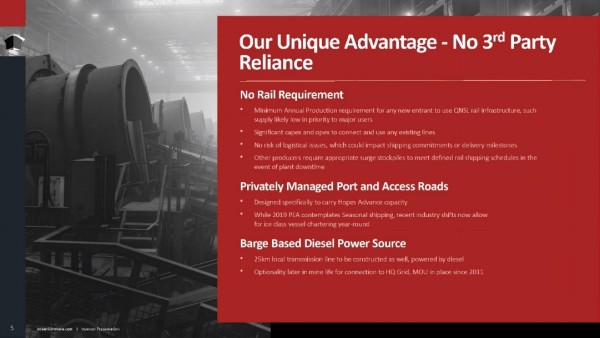
The PEA highlights that Oceanic will not require a railroad to get its iron ore to market, significantly reducing capital expenses and operating costs.
Canada, 23rd Oct 2026 – Global Stocks News – Sponsored content disseminated on behalf of Oceanic Iron Ore. On October 22, 2026, Oceanic Iron Ore (TSXV: FEO) issued a shareholder message titled “No Railway Needed: Our Operational Advantage”.
Oceanic is focused on the development of its 100% owned Hopes Advance, Morgan Lake and Roberts Lake iron ore projects located on the coast, in the Labrador Trough in Québec, Canada.
The flagship Hopes Advance Project has a NI 43-101 Measured & Indicated resource of about 1.36 billion tonnes at a head grade of 32.1% Fe. The project is located at tidewater. The PEA highlights that Oceanic will not require a railroad to get its iron ore to market, significantly reducing capital expenses and operating costs.
No Railway Needed: Our Operational Advantage
Chris Batalha
CEO of Oceanic Iron Ore
The world’s biggest iron ore mines and mining complexes are situated in Western Australia’s Pilbara region, northern Brazil’s Amazon basin, Guinea’s Simandou mountain range, Canada’s Labrador Trough, South Africa’s Northern Cape, and Sweden’s Arctic north. Located far from industrial steel plants, these massive deposits require dedicated heavy-haul rail corridors stretching anywhere from 170 to 900 kilometres to reach specialized deep-sea ports for international markets.
Oceanic’s iron ore assets are located in Northern Québec, close to tidewater. We anticipate that our iron ore concentrate will be transported from the mine to the port via truck along a 26 km access road. This gives us a significant cost, operational and logistical advantage.
Railroad construction costs per kilometre of track vary based on location, the cost of labour, materials and topography. Freight trains can handle a maximum slope of 1.5%. Anything more than that, they lose traction or stall. That’s not a problem if you are building a trans-Saskatchewan rail line. Hills, valleys, mountains and rivers create expensive engineering and construction challenges.
Case in point: The new Simandou iron ore project in Guinea requires a 552-kilometre railway to move its iron ore from a mine site in the mountains 1,200 metres above sea level to the Atlantic coast. An 11-kilometre tunnel was needed to bypass a steep vertical drop. More than 20 bridges were built.
Railroads pose bigger engineering challenges than highways. A single loaded railcar weighs about 130 metric tonnes. To make the tracks stable, construction crews in Guinea had to reinforce the track subgrade across multiple soil profiles. The railway terminates on the Atlantic coast in shallow water. To accommodate Panamax-sized shipping berths, Simandou must build a 20-kilometre-long pier into deeper water.
The cost of building the Simandou iron ore railway and port infrastructure was shared by a consortium of multinational miners, Chinese state-owned steel giants, and the Guinean government. The total bill was approximately US$15 billion. That’s about 10 X our entire projected capex. With no requirement to build a railroad, Oceanic Iron Ore can achieve an attractive payback period with a smaller production profile.
We are based in the Labrador Trough in Quebec, where other iron ore producers require hundreds of kilometres of shared railway. This infrastructure bottleneck leaves operations dependent on third-party scheduling. In addition to upfront capital expenditures for rail development, project economics are heavily influenced by the ongoing operational expenses and fixed tariffs imposed per tonne of ore transported.
A 2019 Technical Report on the Hopes Advance property projected construction costs, mine pre-stripping costs, pre-operational capitalized costs, indirect costs, closure and contingency costs at $1.193 billion.
Major line items in the capex include construction of the mineral processing area ($206.9 million), port ($181.8 million), mine infrastructure ($159.2 million), electric power ($47.6 million) and a mining fleet ($30.3 million). Starting in year five, the total expansion capital cost is estimated at $690 million.
With rising costs of engineering, labour and machinery, our capex today would be higher than the costs cited in the 2019 Tech Report. But with no railroad requirement, we are in a strong position to build a profitable mine delivering high-grade, low-impurity iron ore to the green steel market.
In the next message, I will introduce you to our leadership team.
By Chris Batalha
CEO of Oceanic Iron Ore
Click here to learn more about Oceanic Iron Ore.
Contact: guy.bennett@globalstocksnews.com
Disclaimer: Oceanic Iron Ore paid Global Stocks News (GSN) $1,200 for the dissemination of this content.
Full Disclaimer: GSN researches and fact-checks diligently, but we cannot ensure our publications are free from error. Investing in publicly traded stocks is speculative and carries a high degree of risk. GSN publications may contain forward-looking statements such as “project,” “anticipate,” “expect,” which are based on reasonable expectations, but these statements are imperfect predictors of future events. When compensation has been paid to GSN, the amount and nature of the compensation will be disclosed clearly.
Media Contact
Organization: Global Stocks News
Contact Person: guy.bennett@globalstocksnews.com
Website: https://www.globalstocksnews.com
Email: Send Email
Country: Canada
Release id: 50162
View source version on King Newswire:
Oceanic Iron Ore CEO Chris Batalha Talks About the No Railway Needed Operational Advantage
Disclaimer: The views, suggestions, and opinions expressed here are the sole responsibility of the experts. No journalist was involved in the writing and production of this article.